
In 2026, cloud computing dominates almost every part of the internet infrastructure. Big platforms offer scalable, serverless, and fully managed solutions that can spin up resources in seconds. However, despite all these advancements, VPS hosting (Virtual Private Server) is still highly relevant — and in many cases, it remains the preferred choice for developers, startups, and even growing businesses.
So the question is: why is VPS still alive when cloud services are everywhere?
1. Cost-Effective Performance for Small to Medium Projects
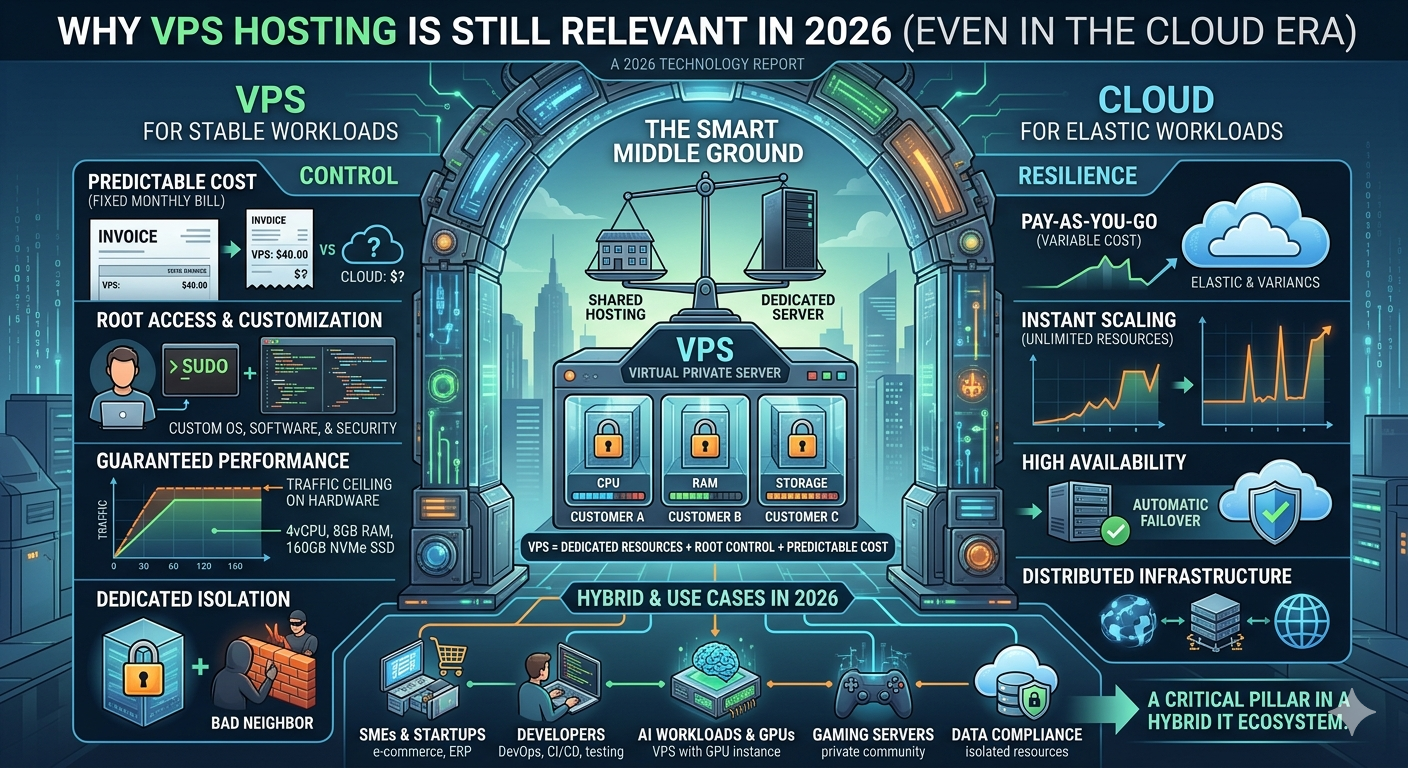
One of the biggest reasons VPS hosting is still popular is cost efficiency. While cloud platforms offer powerful scaling features, they can become expensive quickly, especially when traffic increases or resources are misconfigured.
A VPS provides:
- Fixed monthly cost
- Dedicated portion of resources
- Predictable performance
This makes it ideal for small businesses, personal projects, blogs, and even lightweight applications that don’t need complex cloud architecture.
In 2026, many users still prefer “what you pay is what you get” pricing instead of unpredictable cloud billing.
2. Full Control Over the Server Environment
Unlike shared hosting or some managed cloud platforms, VPS gives users root access and full control over the environment.
This means you can:
- Install custom software
- Configure security settings
- Optimize performance at system level
- Run specific versions of programming languages
For developers, this level of control is very important. It allows flexibility that managed platforms often restrict.
Even in 2026, many DevOps engineers still prefer VPS for testing environments, staging servers, and lightweight production workloads.
3. Better Learning Environment for Students and Developers
VPS hosting is widely used as a learning tool. It gives hands-on experience with:
- Linux server management
- Networking configuration
- Deployment workflows
- Security hardening
Cloud platforms often abstract too many technical layers, making it harder for beginners to understand how servers actually work.
That’s why VPS is still widely used in education and training programs in 2026 — especially for IT students and aspiring system administrators.
4. Reliable Performance Without Complexity
Modern cloud systems are powerful but can be overly complex. Setting up autoscaling groups, load balancers, and microservices architecture is not always necessary for simple applications.
A VPS offers:
- Stable performance
- Simple deployment
- Easier maintenance
For many websites and applications, simplicity is more valuable than advanced scalability.
Small to medium traffic websites often run faster and more consistently on a well-optimized VPS compared to a poorly configured cloud setup.
5. Ideal for Hosting Specific Services
Even in 2026, VPS is widely used for:
- Game servers
- VPN services
- Bot automation
- Small SaaS applications
- API hosting
- Email servers
These workloads don’t always require massive cloud infrastructure. Instead, they benefit from stable, isolated environments that VPS provides.
6. Privacy and Data Control
With increasing concerns about data privacy and compliance, some users prefer VPS because it offers more control over where and how data is stored.
Unlike large cloud providers where data may be distributed across regions automatically, VPS users often know exactly:
- Where their server is located
- Who manages the infrastructure
- How data is handled
This level of transparency is important for businesses handling sensitive data.
7. VPS + Cloud Hybrid Strategy
In 2026, many companies no longer choose between VPS and cloud — they use both.
A common setup looks like:
- VPS for core applications or stable services
- Cloud for scaling, backup, or analytics
This hybrid approach gives the best of both worlds: affordability + scalability.
Conclusion
VPS hosting is not outdated — it has simply evolved into a more specialized role in modern infrastructure.
While cloud computing dominates large-scale systems, VPS remains relevant because it is:
- Affordable
- Flexible
- Easy to control
- Perfect for learning and small-to-medium workloads
In 2026, VPS is not competing with cloud — it is coexisting with it.
And for many developers and businesses, it is still the most practical starting point.