
Many website owners focus heavily on keywords, content, and backlinks when trying to improve their Google rankings. However, one important factor is often ignored—web hosting. The quality of your hosting environment can directly influence your website’s SEO performance, user experience, and search engine visibility.
In 2026, Google continues to prioritize fast, secure, and reliable websites. This means your hosting provider and server configuration play a critical role in how well your website performs in search results.
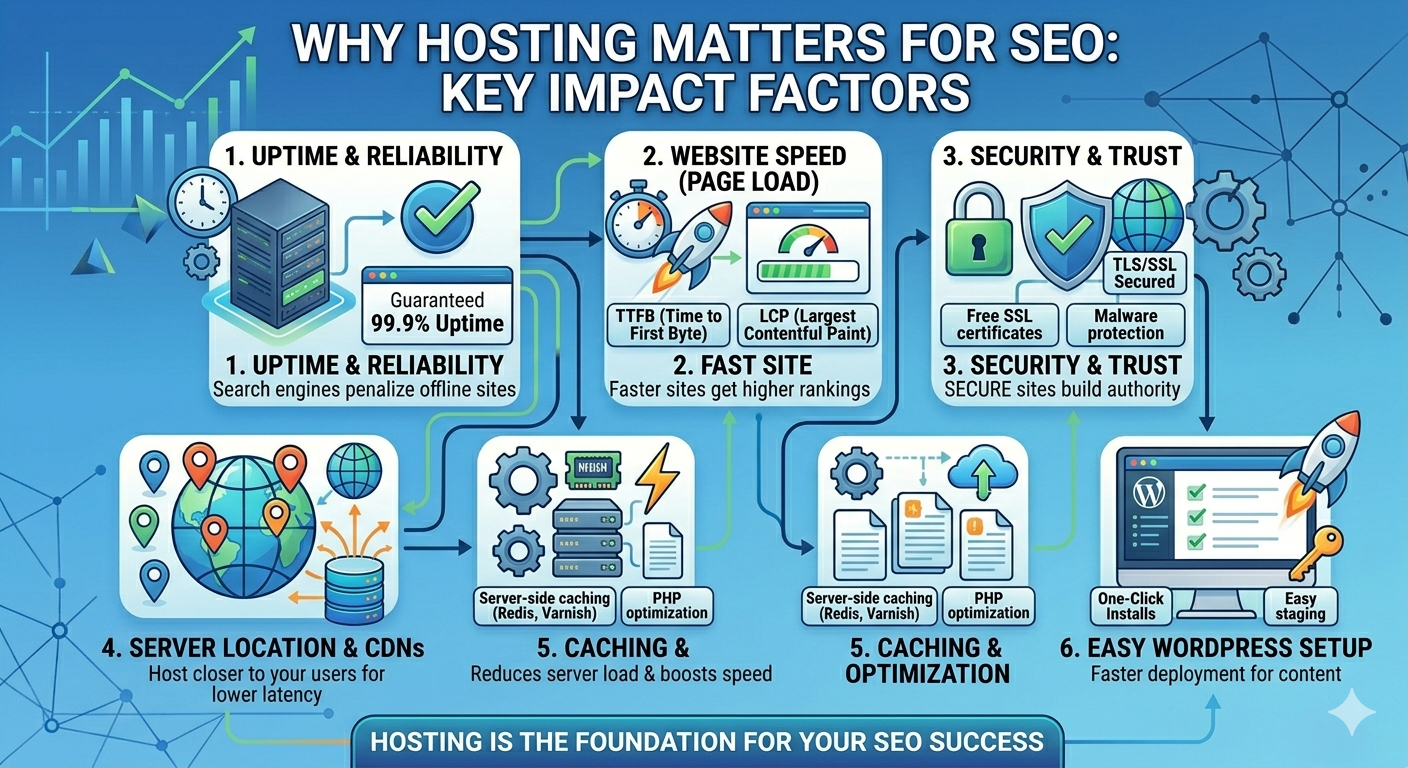
Why Hosting Matters for SEO
Hosting is the foundation of your website. If your server is slow, unstable, or insecure, your entire SEO strategy can be affected.
Google evaluates websites based on user experience signals such as:
- Page loading speed
- Website uptime
- Security (HTTPS)
- Server response time
If your hosting performs poorly in these areas, your rankings may drop even if your content is high quality.
Website Speed and Core Web Vitals
One of the most important ways hosting affects your Google ranking is through website speed. Google uses Core Web Vitals to measure user experience, including loading performance and responsiveness.
A slow server leads to:
- Higher bounce rates
- Lower user engagement
- Poor Core Web Vitals scores
Good hosting improves:
- Faster Time to First Byte (TTFB)
- Better page load speed
- Smoother user experience
Fast hosting with SSD or NVMe storage, optimized servers, and CDN support can significantly improve SEO performance.
Server Uptime and Website Availability
If your website is frequently down, Google will struggle to crawl and index your pages properly. Poor uptime can lead to lower rankings and reduced visibility.
Reliable hosting should offer at least:
- 99.9% uptime guarantee
Frequent downtime can:
- Reduce crawl frequency
- Harm search engine trust
- Cause loss of traffic and rankings
Stable hosting ensures your website remains accessible to both users and search engines at all times.
Server Location and Latency
The physical location of your server also affects SEO performance. The closer your server is to your target audience, the faster your website will load.
For example:
- A website targeting Malaysia should ideally use servers in Asia
- A global website may use CDN distribution
Lower latency improves:
- Page speed
- User experience
- SEO performance signals
Google prefers websites that load quickly for users in their region.
Security and HTTPS (SSL Certificates)
Security is another important ranking factor. Google prioritizes secure websites that use HTTPS encryption.
Good hosting should include:
- Free SSL certificates
- Firewall protection
- DDoS protection
Websites without SSL may show “Not Secure” warnings, which can reduce user trust and increase bounce rates. This indirectly affects SEO rankings.
Server Response Time (TTFB)
Time to First Byte (TTFB) measures how quickly your server responds to a request. Slow hosting leads to high TTFB, which negatively impacts SEO.
Factors affecting TTFB include:
- Server hardware quality
- Hosting configuration
- Database performance
- Network speed
Optimized hosting reduces TTFB and improves overall website performance.
Shared Hosting vs VPS vs Cloud Hosting
The type of hosting you choose also affects SEO performance.
- Shared Hosting: Slower and less reliable due to shared resources
- VPS Hosting: Better performance with dedicated resources
- Cloud Hosting: Highly scalable and optimized for performance
For SEO-focused websites, VPS or cloud hosting is generally a better choice because it provides faster speed and better stability.
Uptime and Google Crawling
Google bots regularly crawl websites to index content. If your server is slow or offline, crawling may be delayed or incomplete.
Good hosting ensures:
- Faster crawling
- More frequent indexing
- Better content visibility
This helps your website appear faster in search results when new content is published.
Performance Optimization Features
Modern hosting providers offer features that directly improve SEO performance, such as:
- Built-in caching systems
- CDN integration
- Optimized server stacks (LiteSpeed, Nginx)
- Automatic compression
These features improve loading speed and user experience, both of which are important ranking factors.
Conclusion
Hosting plays a much bigger role in SEO than many people realize. A good hosting provider improves website speed, uptime, security, and server response time—all of which directly influence Google rankings.
If your hosting is slow or unreliable, even the best SEO strategy will struggle to perform well. On the other hand, a fast and stable hosting environment can significantly boost your search visibility and user experience.
Choosing the right hosting is not just a technical decision—it is an important SEO strategy that impacts your website’s long-term success.