
Search Engine Optimization (SEO) looks simple from the outside. Many beginners think that just writing articles and adding keywords is enough to rank on Google.
But in reality, SEO is much more than that.
A lot of websites fail to get traffic not because SEO is broken, but because of simple mistakes beginners make repeated over and over again.
The good news is: these mistakes are easy to fix once you understand them.
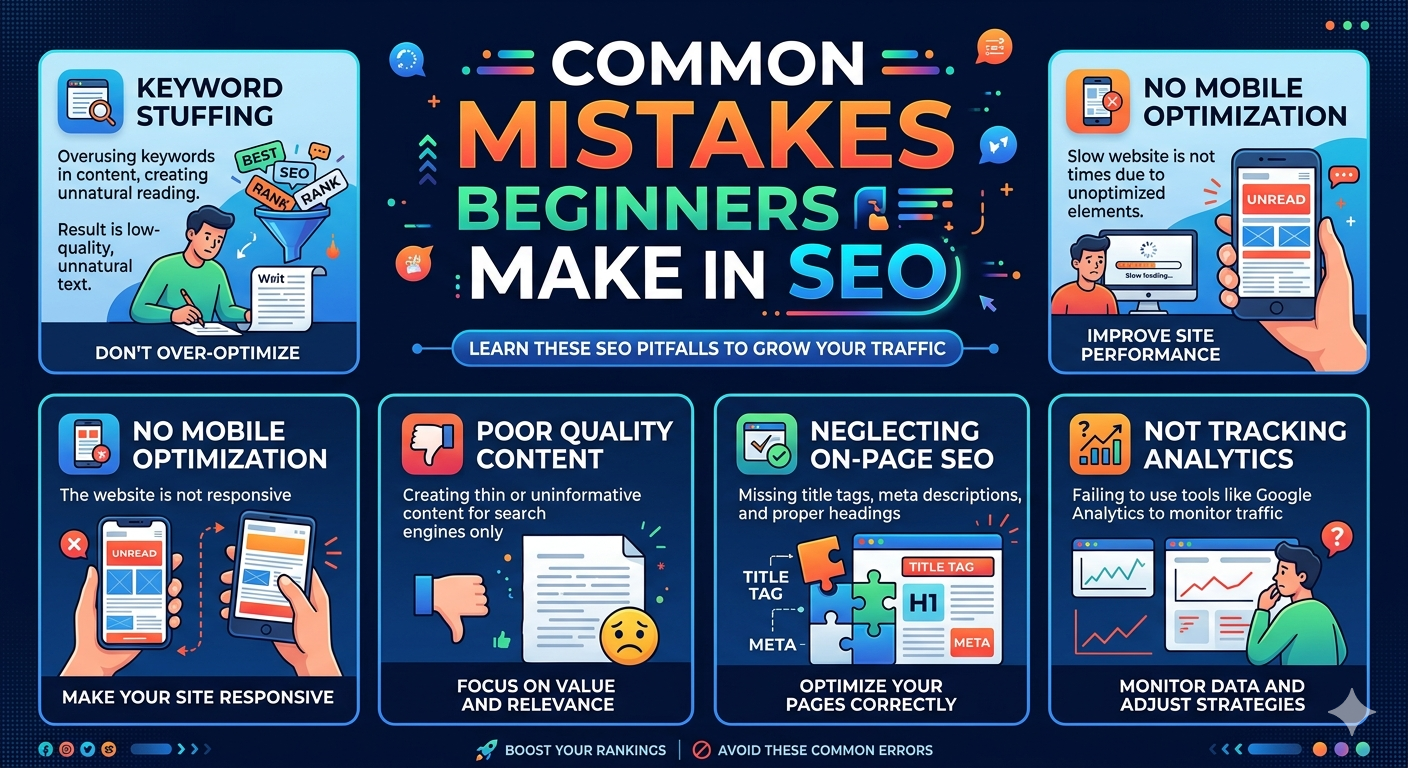
❌ 1. Keyword Stuffing (Overusing Keywords)
One of the most common mistakes in SEO is repeating the same keyword too many times.
Example of bad practice:
“best VPS hosting best VPS hosting best VPS hosting for trading best VPS hosting”
This does not help ranking. Instead, it makes your content:
- Hard to read
- Spammy in Google’s eyes
- Low quality for users
In 2026, Google is smart enough to understand context and synonyms.
✔ Fix:
Use keywords naturally. Instead of repeating, focus on variations like:
- VPS hosting for trading
- reliable VPS server
- fast VPS performance
Write like a human, not a robot.
❌ 2. Ignoring Search Intent
Many beginners focus only on keywords but forget about search intent.
Search intent means:
What does the user actually want?
There are 3 main types:
- Informational (learn something)
- Navigational (find a site/page)
- Transactional (buy something)
Example mistake:
If someone searches “best VPS for trading”, and you write a general definition of VPS, it will not rank well.
✔ Fix:
Always match content with intent:
- Comparison → write comparison
- Buying intent → write product guide
- Learning → write tutorial
❌ 3. Poor Content Structure
A big wall of text is bad for both users and SEO.
Google prefers content that is:
- Easy to scan
- Clearly structured
- Broken into sections
✔ Fix:
Use:
- Headings (H2, H3)
- Short paragraphs
- Bullet points
- Clear spacing
This improves readability and ranking signals.
❌ 4. No Internal Linking Strategy
Many beginners publish articles but never connect them.
Without internal linking:
- Google struggles to understand site structure
- Pages don’t support each other
- Authority is not distributed properly
✔ Fix:
Link related articles together.
Example:
- VPS article → link to “best VPS providers”
- SEO article → link to “keyword research guide”
This creates a strong website structure.
❌ 5. Low-Quality Backlinks
Backlinks are important, but quality matters more than quantity.
Common beginner mistakes:
- Buying cheap backlinks
- Spam comments on blogs
- Irrelevant forum links
These can actually hurt SEO instead of helping.
✔ Fix:
Focus on:
- Relevant forums (like Reddit discussions)
- Guest posting on niche websites
- Natural mentions from useful content
❌ 6. Weak or Generic Titles
Your title is the first thing users and Google see.
Bad title:
“SEO guide”
Good title:
“Top 7 SEO Mistakes Beginners Make in 2026 (And How to Fix Them Fast)”
✔ Fix:
A strong title should include:
- Keyword
- Clear benefit
- Emotional or power word (Top, Best, Fast, Complete)
This improves click-through rate (CTR).
❌ 7. Giving Up Too Early
SEO is not instant.
Many beginners stop because:
- No traffic in 1 week
- Only a few articles published
- Expecting fast results
But SEO takes time to build authority.
✔ Fix:
Be consistent:
- Publish regularly
- Improve old content
- Track performance over months
Real SEO results usually appear after 2–3 months minimum.
🧠 8. Not Updating Old Content (NEW POINT)
One mistake many beginners ignore is never updating old articles.
Google prefers fresh and updated content.
If your article is outdated:
- Ranking drops slowly
- Competitors replace your position
- Traffic becomes unstable
✔ Fix:
Every few months:
- Update stats
- Improve headings
- Add new sections
- Refresh keywords
This helps maintain rankings long-term.
📊 Bonus Tip: Focus on Value, Not Tricks
In 2026, Google prioritizes:
- Helpful content
- Real experience
- User satisfaction
One strong article is better than 10 weak ones.
🧭 Conclusion
Most SEO failures come from simple, avoidable mistakes.
To succeed in 2026:
- Write naturally
- Understand user intent
- Structure content properly
- Build quality backlinks
- Stay consistent
- Update old content
SEO is not about tricks — it is about building useful content that deserves to rank.