
When you see hosting providers advertising “unlimited bandwidth,” it sounds like the perfect deal. No limits, no extra charges, and no worries about traffic spikes. But in reality, “unlimited bandwidth” is not truly unlimited, and understanding what it actually means can help you avoid performance issues and unexpected restrictions.
In web hosting, bandwidth is one of the most misunderstood terms, and marketing language often hides how it really works behind the scenes.
 What Is Bandwidth in Hosting?
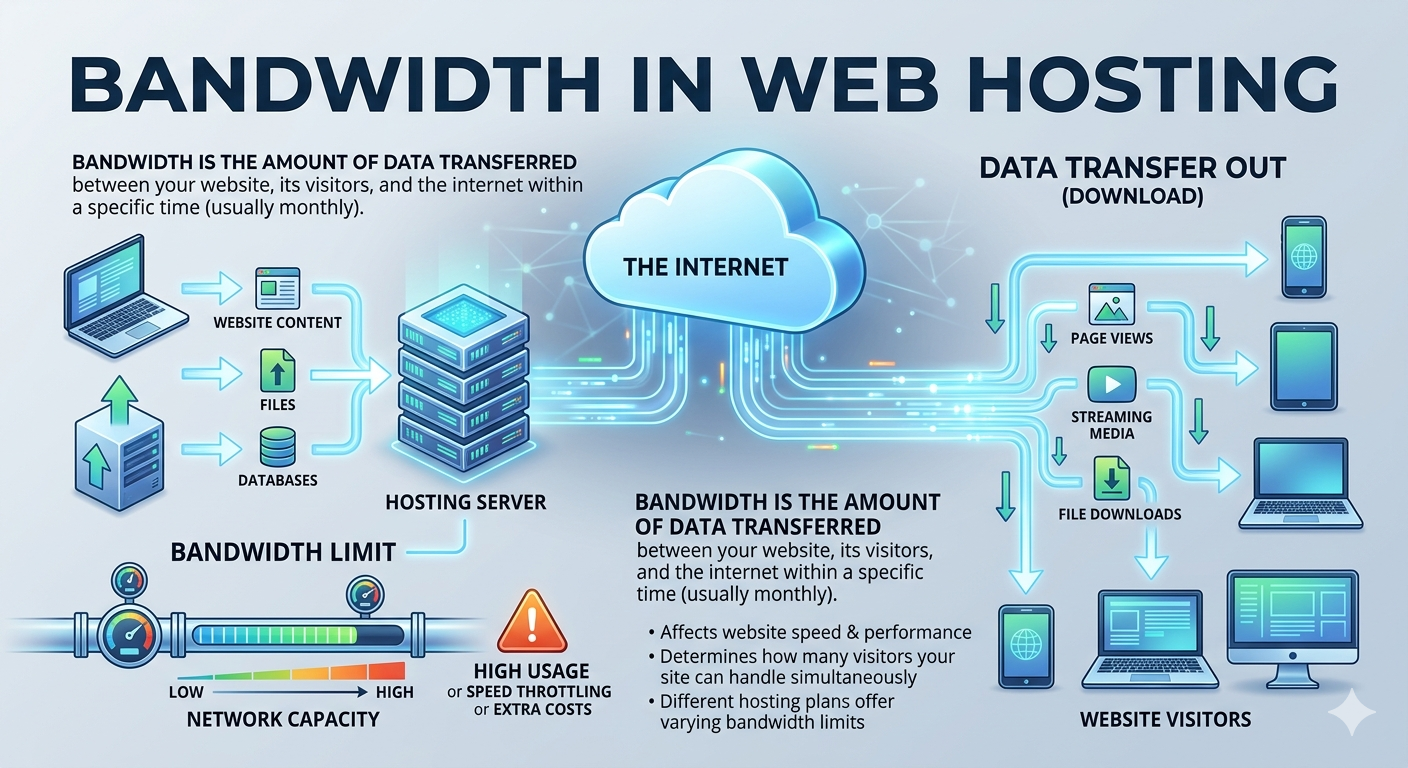
Bandwidth refers to the amount of data your website can transfer to users over a specific period of time, usually measured monthly. Every time someone visits your website, data is transferred from your server to their device.
This includes:
- Website text and HTML files
- Images and videos
- CSS and JavaScript files
- API responses and database content
So, the more visitors you have—and the heavier your website—the more bandwidth you use.
So What Does “Unlimited Bandwidth” Really Mean?
Despite the term, “unlimited bandwidth” does not mean infinite resources. Instead, it usually means:
- There is no fixed monthly cap advertised
- You are expected to stay within normal usage limits
- Providers apply a Fair Usage Policy (FUP)
In simple terms, you can use “as much as you want” until your usage is considered excessive.
This is where the reality starts to differ from marketing.
The Hidden Reality: Fair Usage Policy
Most hosting companies include a Fair Usage Policy that allows them to manage server resources. If your website uses too much bandwidth or affects other users on shared hosting, the provider may:
- Throttle your speed
- Temporarily suspend your account
- Request you to upgrade your plan
- Move you to a higher-tier hosting package
So even though it is labeled “unlimited,” it is actually controlled usage based on server capacity.
Why Hosting Companies Offer “Unlimited” Plans
The main reason is simple: overselling and shared resources.
On shared hosting, hundreds or even thousands of websites may run on the same server. Not all websites use maximum bandwidth at the same time.
Hosting providers rely on the fact that:
- Most users use low to moderate traffic
- Only a small percentage use high resources
- Server capacity is shared efficiently
This allows them to offer “unlimited” plans at low prices while still maintaining profitability.
When “Unlimited Bandwidth” Becomes Limited
Your hosting plan may start showing limits when:
- Your website traffic suddenly increases
- You host large files or videos
- Your site consumes too many server resources
- You generate heavy API or database requests
Even if bandwidth is technically unlimited, other factors like CPU, RAM, and I/O speed can become the real bottleneck.
This is why many users experience slow websites even when they think bandwidth is not the issue.
Bandwidth vs Server Performance
Many beginners assume bandwidth is the only factor affecting speed. In reality, performance depends on multiple layers:
- CPU usage (processing power)
- RAM (memory handling)
- Disk speed (SSD/NVMe performance)
- Network latency
- Concurrent connections
Even with “unlimited bandwidth,” a weak server can still make your website slow or unstable.
The Role of Traffic Spikes
One major limitation of “unlimited” hosting is handling sudden traffic spikes.
For example:
- Viral content
- Marketing campaigns
- Seasonal traffic increases
- Product launches
Shared hosting environments are often not designed for sudden heavy load. When this happens, providers may temporarily limit your usage to protect overall server stability.
How CDNs Help Reduce Bandwidth Pressure
A Content Delivery Network (CDN) can significantly reduce bandwidth usage on your main server.
A CDN works by:
- Storing cached versions of your website
- Serving content from locations closer to users
- Reducing direct requests to your hosting server
This helps:
- Lower bandwidth consumption
- Improve loading speed
- Reduce server stress
- Handle global traffic more efficiently
Even with “unlimited bandwidth,” using a CDN is one of the best optimization strategies.
Is Unlimited Bandwidth a Scam?
Not exactly—but it is marketing-driven terminology.
It is not a scam because:
- You are still getting usable bandwidth
- Most users never hit restrictions
- Providers clearly state fair usage terms
However, it can be misleading if users assume it means infinite, unrestricted performance.
The key is understanding that hosting is always limited by physical server resources.
How to Choose the Right Hosting Plan
Instead of focusing only on “unlimited bandwidth,” consider:
- Real resource limits (CPU, RAM, storage type)
- Data center location
- Network quality and uptime
- Scalability options (VPS or dedicated server upgrades)
- Provider reputation and transparency
For growing websites, VPS or dedicated servers are often more reliable than shared “unlimited” plans.
Conclusion
“Unlimited bandwidth” sounds attractive, but in reality, it comes with conditions, fair usage policies, and hidden resource limits. It is designed to simplify marketing, not to represent infinite capacity.
Understanding how bandwidth actually works helps you make better hosting decisions and avoid surprises when your website starts growing.
In the end, performance is not just about bandwidth—it is about how well your hosting environment handles real-world traffic and resource demands.