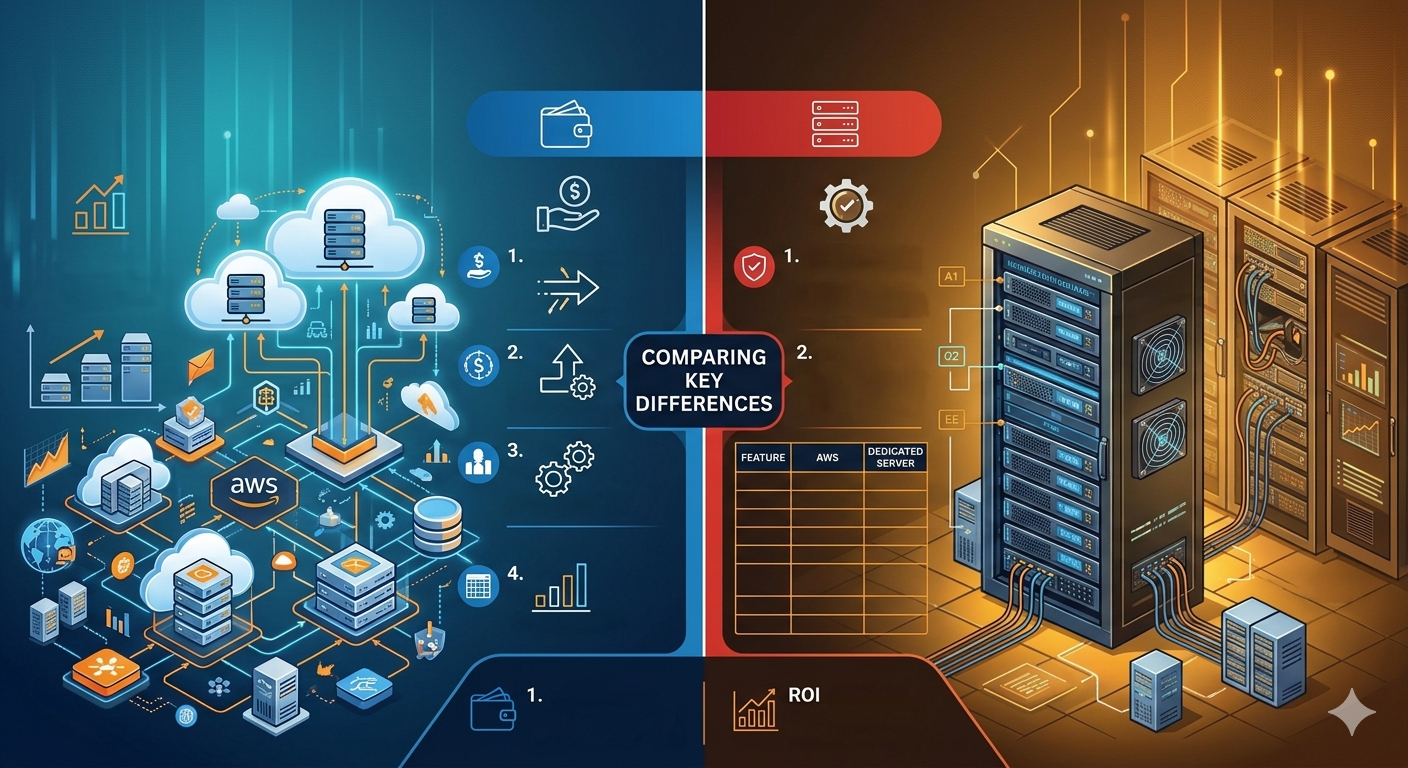
When businesses compare cloud platforms like AWS vs dedicated servers, the conversation often revolves around scalability, flexibility, and performance.
But here’s the reality most providers don’t highlight:
the biggest difference isn’t performance — it’s cost over time.
While cloud solutions appear affordable at the beginning, many businesses eventually face rising and unpredictable expenses. In this article, we’ll break down the hidden costs of AWS and compare them with dedicated servers so you can make a smarter decision.
1. Pay-As-You-Go Sounds Cheap Until It’s Not
AWS operates on a “pay-as-you-go” pricing model. On paper, this sounds efficient — you only pay for what you use.
However, in real-world scenarios:
- Traffic spikes lead to sudden cost increases
- Additional storage automatically raises your bill
- Running multiple services compounds your monthly expenses
Over time, your hosting cost becomes difficult to predict and control.
With dedicated servers, you pay a fixed monthly fee, which makes budgeting much easier and eliminates unexpected charges.
2. Data Transfer Fees Add Up Quickly
One of the most overlooked costs in AWS is data transfer (egress fees).
- Sending data out of AWS is not free
- High-traffic websites generate significant outbound data
- APIs and applications constantly moving data increase usage
Many businesses only realize this after receiving a surprisingly high bill.
Dedicated servers, on the other hand, often include:
- high bandwidth limits
- or even unmetered traffic
This makes them far more predictable for websites with consistent or heavy traffic.
3. Essential Add-Ons That Increase Costs
AWS provides the infrastructure, but most real-world applications require additional services such as:
- Load balancers
- Backup solutions
- Monitoring tools
- Advanced security layers
Each of these comes with its own pricing.
What starts as a low-cost setup can quickly turn into a complex and expensive system.
With dedicated servers, many of these features are either:
- included in the package
- or available at a much lower cost
4. Technical Complexity = Hidden Operational Cost
AWS is powerful, but it’s not beginner-friendly.
To run AWS efficiently, businesses often need:
- experienced cloud engineers
- DevOps specialists
- ongoing infrastructure management
This creates a hidden human cost that many companies underestimate.
Dedicated servers are generally:
- simpler to deploy
- easier to manage
- less dependent on specialized teams
5. Real Cost Comparison (Example)
Let’s look at a simplified monthly scenario:
AWS Setup:
- EC2 instance: $120
- Storage (EBS): $40
- Bandwidth: $100+
- Load balancer: $25
- Backups & monitoring: $30
Total: $315+ (can increase anytime)
Dedicated Server:
- Full server resources
- High bandwidth included
- Fixed pricing
Total: $180–$250 (predictable monthly cost)
The difference becomes even bigger as your traffic grows.
6. AWS vs Dedicated Server (Quick Comparison)
| Feature | AWS | Dedicated Server |
|---|---|---|
| Pricing | Variable | Fixed |
| Cost Predictability | Low | High |
| Scalability | Very High | Moderate |
| Performance | Shared resources | Full control |
| Technical Complexity | High | Medium |
| Long-Term Cost | Expensive | Cost-efficient |
7. When Should You Use Each?
Choose AWS if:
- You’re running a startup or MVP
- Your traffic is highly unpredictable
- You need rapid scaling and flexibility
Choose Dedicated Servers if:
- You run an e-commerce or SaaS business
- Your traffic is stable or growing steadily
- You want predictable monthly costs
- You prioritize long-term ROI
8. Common Mistakes Businesses Make
Many companies overspend on cloud services because of these common mistakes:
- Underestimating bandwidth usage
- Over-provisioning resources “just in case”
- Paying for unused services
- Not optimizing cloud infrastructure
These issues silently increase your monthly bill without delivering real value.
9. Long-Term ROI: The Real Deciding Factor
Cloud platforms like AWS are excellent for flexibility.
But for long-term operations, especially:
- high-traffic websites
- established businesses
- predictable workloads
Dedicated servers often provide better return on investment (ROI).
Why?
- no surprise costs
- consistent performance
- full resource allocation
Final Thoughts
Cloud isn’t always cheaper — it’s just more flexible.
If your business is scaling and your AWS bill keeps increasing every month, it might be time to reconsider your infrastructure strategy.
Switching to a dedicated server can:
- reduce operational costs
- simplify management
- improve performance consistency
Looking for a More Cost-Effective Solution?
If you’re currently using AWS and struggling with rising costs, consider switching to a dedicated hosting solution with ServerGigabit.
✔ Fixed monthly pricing
✔ High-performance infrastructure
✔ No hidden fees
A smarter choice for businesses that want stability and long-term savings.