
When selecting storage for a high-performance dedicated server, one of the most important decisions is choosing between NVMe vs SATA. While both are widely used in modern hosting environments, they differ significantly in speed, architecture, and real-world performance.
Understanding these differences is essential for businesses that rely on fast data processing, low latency, and stable server performance.
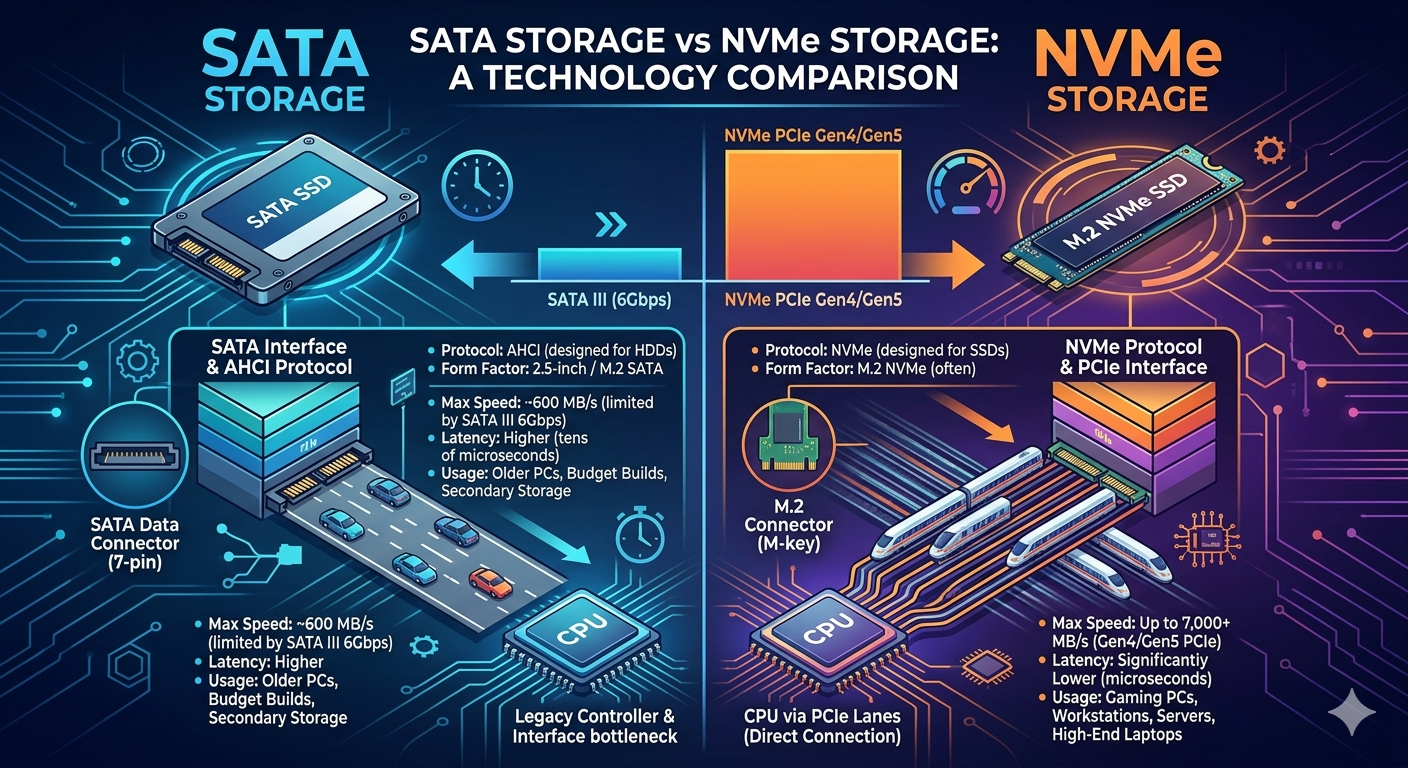
What is SATA Storage?
SATA (Serial ATA) is one of the most common storage interfaces used in traditional SSDs and HDDs.
It has been widely used for years due to its affordability and reliability. SATA SSDs are significantly faster than traditional hard drives, making them suitable for general-purpose hosting and basic server workloads.
However, SATA is limited by its interface bandwidth, which caps its maximum performance.
Key Characteristics of SATA:
- Lower cost compared to NVMe
- Reliable and widely supported
- Suitable for general hosting workloads
- Limited by older interface technology
What is NVMe Storage?
NVMe (Non-Volatile Memory Express) is a newer storage technology designed specifically for SSDs using the PCIe interface.
Unlike SATA, NVMe communicates directly with the CPU through PCIe lanes, allowing much faster data transfer speeds and lower latency.
This makes NVMe the preferred choice for modern high-performance dedicated servers.
Key Characteristics of NVMe:
- Extremely high read/write speeds
- Low latency and fast response time
- Direct CPU communication via PCIe
- Ideal for high-performance applications
NVMe vs SATA: Performance Comparison
The main difference between NVMe and SATA lies in speed and efficiency.
Speed:
- SATA SSD: Up to ~550 MB/s
- NVMe SSD: Can exceed 3,000–7,000 MB/s depending on generation
NVMe is significantly faster, making it more suitable for demanding workloads.
Latency:
NVMe has much lower latency compared to SATA, which means faster response times for applications, databases, and real-time services.
Parallel Processing:
NVMe supports multiple queues and thousands of commands simultaneously, while SATA is limited to a single queue.
This gives NVMe a major advantage in handling heavy workloads.
When to Use SATA Storage
SATA is still a good choice in certain scenarios, especially when performance demands are moderate.
Use SATA if you are running:
- Small websites or blogs
- Low-traffic applications
- Budget hosting environments
- Backup storage systems
It provides a balance between cost and performance.
When to Use NVMe Storage
NVMe is designed for high-performance environments where speed matters.
It is ideal for:
- High-traffic websites
- E-commerce platforms
- SaaS applications
- Game servers
- Database-heavy applications
- Real-time processing systems
If your business relies on fast response times, NVMe is the better option.
Impact on Dedicated Server Performance
In a dedicated server environment, storage type plays a major role in overall system performance.
Choosing NVMe over SATA can result in:
- Faster website loading times
- Improved database performance
- Better handling of concurrent users
- Reduced server response delays
For businesses targeting performance-sensitive users, NVMe provides a noticeable advantage.
Cost vs Performance Consideration
While NVMe offers superior performance, it typically comes at a higher cost compared to SATA.
However, the cost difference is often justified for production workloads where performance directly impacts user experience and revenue.
SATA remains a cost-effective option for non-critical workloads, while NVMe is a long-term performance investment.
Conclusion
Choosing between NVMe and SATA depends on your workload requirements and performance expectations.
- SATA is suitable for basic, budget-friendly hosting needs
- NVMe is the preferred choice for high-performance dedicated servers
For modern applications that demand speed, scalability, and reliability, NVMe storage provides a significant advantage and is becoming the standard in high-performance hosting environments.
FAQ
Is NVMe better than SATA for dedicated servers?
Yes, NVMe is significantly faster than SATA and provides lower latency, making it better for high-performance server environments.
Why is NVMe faster than SATA?
NVMe uses PCIe lanes and communicates directly with the CPU, while SATA is limited by older interface technology.
Is SATA still good for servers?
Yes, SATA is still suitable for low-traffic websites, backups, and budget hosting setups.
Should I choose NVMe for hosting?
If your application requires speed, scalability, and high traffic handling, NVMe is the better choice.