
Dedicated Server vs Public Cloud:
As businesses scale, choosing the right infrastructure becomes a critical financial and operational decision. Two of the most common options for modern enterprises are dedicated servers and public cloud platforms.
While both offer powerful capabilities, the real question is not just about performance—it is about return on investment (ROI) over the long term.
This article breaks down the key differences to help growing enterprises decide which infrastructure delivers better value.
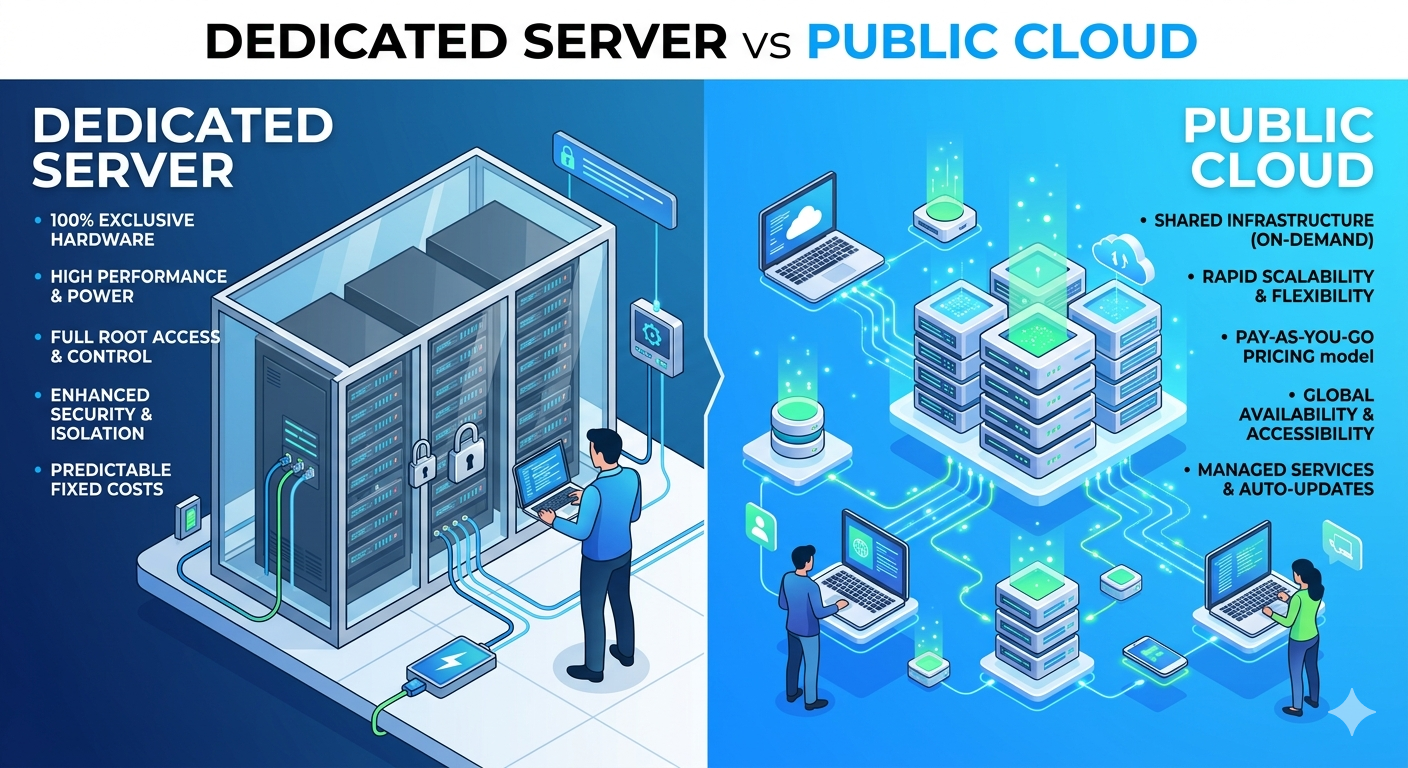
1. Cost Structure and Predictability
One of the biggest differences between dedicated servers and public cloud is pricing model.
Dedicated Server:
- Fixed monthly cost
- Predictable expenses
- No surprise billing
Public Cloud:
- Pay-as-you-go pricing
- Variable monthly cost
- Can increase significantly under heavy usage
For enterprises that need financial stability, dedicated servers often provide better cost predictability and ROI control.
2. Performance Consistency
Performance plays a direct role in user experience and revenue generation.
Dedicated servers offer:
- Dedicated CPU, RAM, and storage
- No resource sharing
- Stable performance under load
Public cloud environments may experience:
- Resource contention in multi-tenant systems
- Performance fluctuations depending on workload
For consistent enterprise applications, stability often translates to better ROI.
3. Scalability Approach
Public cloud platforms are well known for their scalability.
They provide:
- On-demand scaling
- Elastic resource allocation
- Global infrastructure support
Dedicated servers scale differently:
- Hardware upgrades required
- Manual scaling process
- More planning needed
However, for predictable workloads, dedicated infrastructure can be more cost-efficient in the long run.
4. Total Cost of Ownership (TCO)
ROI is closely tied to total cost of ownership.
Dedicated Server TCO:
- Lower long-term cost for stable workloads
- No per-resource billing
- Easier budgeting
Public Cloud TCO:
- Higher cost for continuous high usage
- Additional charges for storage, bandwidth, and requests
- Complex billing structure
For enterprises with steady traffic, dedicated servers often deliver better ROI over time.
5. Security and Data Control
Security is a major consideration for enterprise infrastructure.
Dedicated servers provide:
- Full isolation
- Complete control over security configurations
- No shared environment risks
Public cloud offers strong security features but:
- Operates in shared infrastructure
- Requires careful configuration to avoid mismanagement risks
Industries with strict compliance requirements often prefer dedicated environments.
6. Customization and Control
Dedicated servers give businesses full control over infrastructure:
- Operating system selection
- Firewall configuration
- Software stack optimization
- Hardware-level tuning
Public cloud environments are more standardized, which may limit deep customization.
For specialized enterprise workloads, control often improves performance efficiency and ROI.
7. Long-Term ROI Strategy
When evaluating ROI, businesses must consider long-term growth, not just initial cost.
Dedicated Server ROI Advantages:
- Stable pricing
- High performance consistency
- Lower cost for sustained workloads
Public Cloud ROI Advantages:
- Fast deployment
- Flexible scaling
- Ideal for short-term or variable workloads
The best ROI depends on usage pattern:
- Stable workload → Dedicated server advantage
- Highly dynamic workload → Public cloud advantage
Dedicated Server vs Public Cloud: Summary Comparison
| Factor | Dedicated Server | Public Cloud |
|---|---|---|
| Cost | Predictable | Variable |
| Performance | Stable | Variable |
| Scalability | Manual | Automatic |
| Security | High isolation | Shared infrastructure |
| ROI (steady workloads) | Strong | Moderate |
| ROI (variable workloads) | Moderate | Strong |
Conclusion
Choosing between a dedicated server and public cloud is not about which technology is better overall—it is about which one aligns with your business workload and financial strategy.
For growing enterprises with stable and predictable workloads, dedicated servers often provide stronger long-term ROI due to fixed costs, consistent performance, and full infrastructure control.
On the other hand, public cloud platforms are better suited for businesses with highly dynamic or unpredictable scaling needs.
The smartest infrastructure strategy is not choosing one over the other blindly—but matching the right solution to your operational reality.
FAQ
Which is better for ROI: dedicated server or public cloud?
It depends on workload. Dedicated servers offer better ROI for stable, long-term usage, while public cloud is better for variable workloads.
Is a dedicated server cheaper than public cloud?
For consistent usage, yes. Dedicated servers usually have fixed pricing, making them more cost-effective over time.
Why do enterprises still use dedicated servers?
Because they offer predictable costs, high performance stability, and full control over infrastructure.
When should a business use public cloud instead?
Public cloud is ideal for startups, fluctuating workloads, and applications requiring rapid scaling.