
Introduction
Why backend systems matter more than people realize is a critical concept in modern web development. Most users only see the frontend interface—buttons, colors, and layout—but the real power of any application lies in the backend systems running behind the scenes.
From social media apps to banking platforms, backend systems are what make everything work reliably, securely, and at scale.
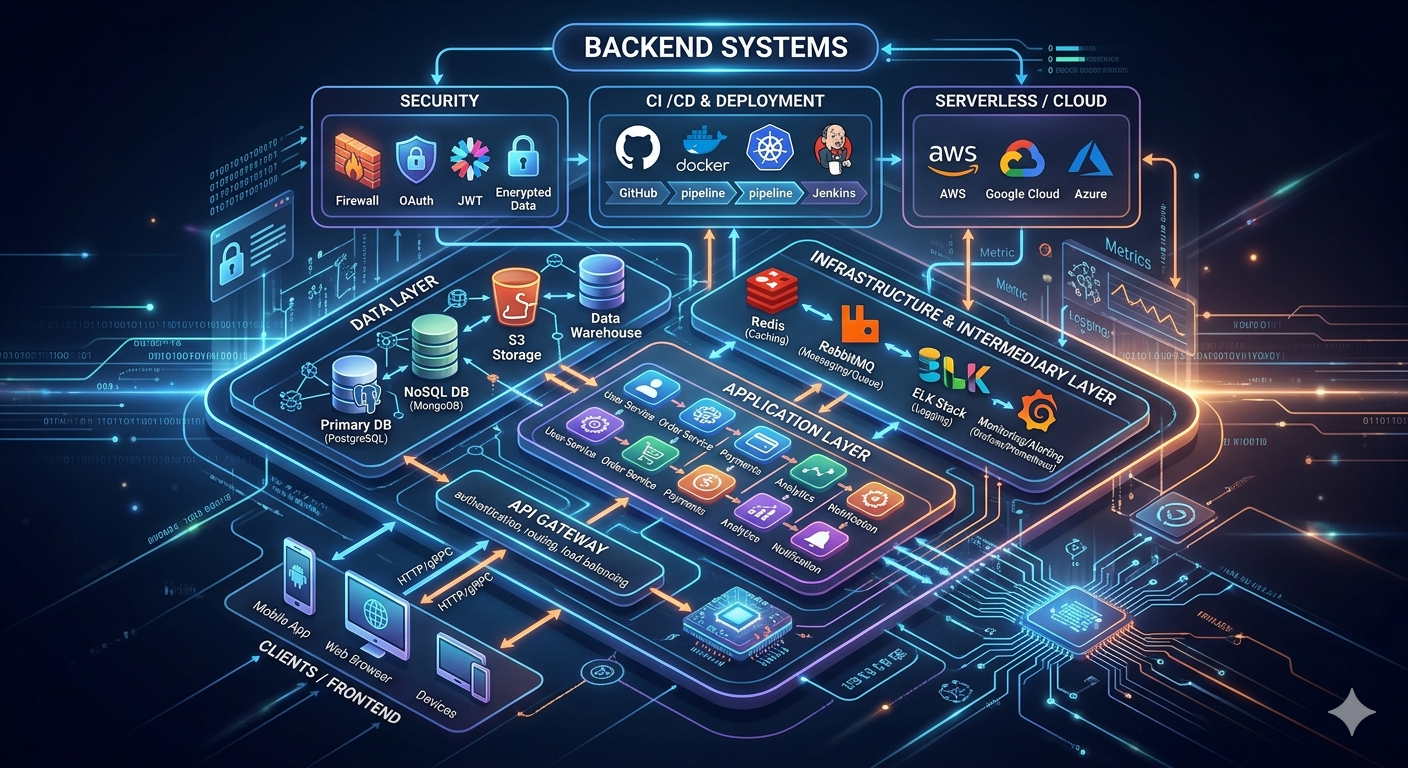
1. What Are Backend Systems?
Backend systems refer to the server-side components of an application, including:
- Servers
- Databases
- APIs
- Authentication systems
- Business logic
Unlike frontend (what users see), backend handles everything users don’t see but depend on.
2. Backend Controls All Data Processing
One major reason why backend systems matter more than people realize is because they handle all data processing.
When a user:
- Logs in
- Sends a message
- Searches for a product
The backend:
- Processes the request
- Validates data
- Retrieves or stores information
- Sends response back
Without backend systems, no application can function dynamically.
3. Security Depends on Backend Systems
Security is primarily enforced at the backend level.
Backend systems handle:
- User authentication
- Password encryption
- Token validation
- Access control
If backend security is weak:
- Data breaches can happen
- User accounts can be compromised
- Sensitive information can be exposed
This is why backend is the foundation of application security.
4. Scalability Is Controlled by Backend Architecture
Backend systems determine how well an application scales.
Good backend systems use:
- Load balancing
- Microservices architecture
- Distributed databases
- Auto-scaling infrastructure
Poor backend design leads to:
- Server crashes under traffic
- Slow response times
- System downtime
Scalability is almost entirely a backend responsibility.
5. Backend Affects Performance and Speed
Many people think website speed depends only on design, but backend plays a bigger role.
Backend performance depends on:
- Database query speed
- Server processing power
- API response time
- Caching efficiency
Even a beautifully designed website will feel slow if backend is inefficient.
6. APIs Rely Entirely on Backend Systems
APIs act as the communication bridge between frontend and backend.
Backend systems:
- Process API requests
- Return structured data (usually JSON)
- Handle business logic
Example:
When you use a mobile app, every action triggers a backend API call.
Without backend systems, APIs cannot function at all.
7. Real-World Example (Social Media Apps)
Take a platform like Instagram or TikTok:
Frontend:
- Displays posts
- Shows UI
- Handles user interaction
Backend:
- Stores user data
- Processes video uploads
- Manages feeds
- Handles likes and comments
If backend fails:
- App cannot load feeds
- Messages stop working
- Uploads fail
This shows clearly why backend systems matter more than people realize.
8. Backend Handles Business Logic
Business logic is the set of rules that define how an application behaves.
Examples:
- Discount calculations in e-commerce
- Ride matching in Grab/Uber
- Video recommendations in YouTube
This logic is entirely handled by backend systems.
9. Data Storage and Management
Backend systems are responsible for storing and managing data securely.
They use:
- SQL databases (MySQL, PostgreSQL)
- NoSQL databases (MongoDB)
Good data design ensures:
- Fast retrieval
- Data integrity
- Reliable storage
Poor database design leads to slow systems and data issues.
🔥 Why Backend Systems Are Often Ignored
Many beginners focus on frontend because:
- It is visible
- It is easier to learn visually
- It gives instant results
But in real systems, backend is what determines:
- Stability
- Security
- Performance
- Scalability
🌍 Real-World Comparison
App with Strong Backend
✔ Fast response
✔ Stable under traffic
✔ Secure user data
✔ Scalable architecture
App with Weak Backend
✖ Slow loading
✖ Frequent crashes
✖ Data errors
✖ Poor user experience
📊 Conclusion
Why backend systems matter more than people realize comes down to one key fact: the backend is the foundation of every digital application. Without it, frontend interfaces would have no data, no logic, and no functionality.
Backend systems power everything users interact with—even if they never see it.