
Introduction
When choosing a hosting plan, one of the most important technical decisions is storage type. Most providers offer either SSD or NVMe storage, but many users do not fully understand the real difference between them.
At first glance, both seem fast enough for modern websites. However, when performance, scalability, and traffic handling come into play, the difference becomes more noticeable.
So the real question is: does SSD vs NVMe actually affect hosting speed, or is it just marketing?
In this guide, we will break down how both technologies work, their real-world performance differences, and which one is better for different types of websites in 2026.
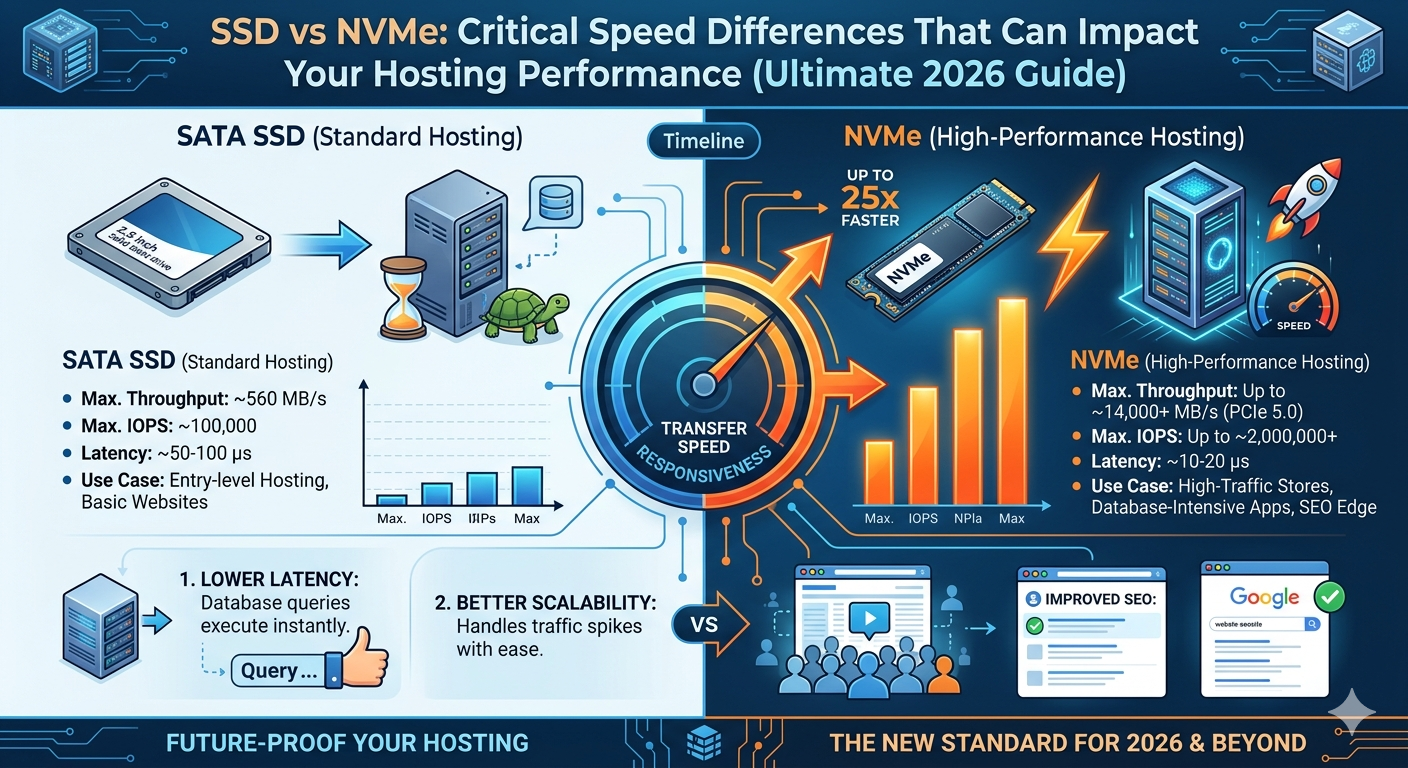
What Is SSD Hosting?
SSD (Solid State Drive) storage is a modern replacement for traditional hard disk drives (HDD). Instead of mechanical parts, SSD uses flash memory, making it much faster and more reliable.
Key advantages of SSD:
- Faster data access compared to HDD
- Lower latency
- More stable performance
- Better durability (no moving parts)
SSD hosting became the industry standard because it significantly improved website loading speeds compared to older HDD systems.
However, SSD still has limitations in high-performance environments.
What Is NVMe Hosting?
NVMe (Non-Volatile Memory Express) is a newer storage technology designed specifically for high-speed data transfer between storage and CPU.
Unlike SSDs that use SATA connections, NVMe uses PCIe lanes, which are much faster and more efficient.
Key advantages of NVMe:
- Extremely high read/write speeds
- Much lower latency than SSD
- Better handling of heavy workloads
- Superior database performance
- Faster response under high traffic
NVMe is currently one of the fastest storage technologies available in hosting.
⚡ SSD vs NVMe: Real Performance Comparison
| Feature | SSD | NVMe |
|---|---|---|
| Speed | Fast | Extremely fast |
| Latency | Low | Very low |
| Traffic Handling | Good | Excellent |
| Database Performance | Moderate | High |
| Scalability | Medium | High |
| Cost | Lower | Higher |
👉 NVMe can be several times faster than SSD, especially in data-heavy environments.
🚀 Does SSD vs NVMe Really Affect Hosting Speed?
= YES, but not always equally.
The impact depends on your website type, traffic level, and application complexity.
🟢 When SSD is Enough
SSD hosting is perfectly suitable for:
- Personal blogs
- Small business websites
- Portfolio sites
- Static websites
- Low traffic landing pages
For these use cases, SSD already provides fast and stable performance, and the difference with NVMe may not be very noticeable.
🔴 When NVMe Makes a Big Difference
NVMe becomes very important when performance demands increase.
It is ideal for:
- E-commerce websites
- SaaS applications
- High traffic websites
- Database-heavy systems
- Web apps with real-time requests
In these cases, NVMe significantly improves response time and reduces bottlenecks.
📊 Real Impact on Website Performance
Storage type affects several key areas:
1. Page Loading Speed
NVMe reduces the time needed to load dynamic content and database-driven pages.
2. Server Response Time
Faster storage means faster response from the server when handling requests.
3. Database Queries
Websites that rely heavily on databases benefit greatly from NVMe speed improvements.
4. Traffic Spikes
NVMe handles sudden traffic increases more efficiently compared to SSD.
5. User Experience
Faster websites lead to:
- Lower bounce rates
- Higher engagement
- Better conversion rates
🔍 SSD vs NVMe and SEO Impact
Website speed is a confirmed ranking factor for search engines.
Faster storage contributes to:
- Better Core Web Vitals scores
- Lower page load times
- Improved user experience metrics
- Higher SEO rankings
👉 NVMe can indirectly improve SEO performance, especially for larger or dynamic websites.
💡 Performance Reality Check
It is important to understand that storage is only one part of server performance.
Even if NVMe is extremely fast, overall speed also depends on:
- CPU power
- RAM allocation
- Website optimization
- Caching setup
- Network quality
👉 NVMe improves storage speed, but full optimization requires a balanced server setup.
⚠️ Common Misconceptions
❌ “NVMe will make any website ultra-fast instantly”
Not true. It improves storage speed, but other bottlenecks may still exist.
❌ “SSD is outdated and slow”
Not true. SSD is still very fast for most small websites.
❌ “Storage is the only factor that matters”
False. Hosting performance is a combination of multiple resources.
🧠 How to Choose Between SSD and NVMe
Choose SSD if:
- You run a small or medium website
- You want affordable hosting
- Your traffic is stable or low
- You don’t run heavy database operations
Choose NVMe if:
- You run a business-critical website
- You expect high traffic growth
- You use database-heavy applications
- You need maximum performance and scalability
🔮 Future of Hosting Storage
The industry is moving toward NVMe as the standard for high-performance hosting.
However, SSD will still remain widely used because:
- It is more affordable
- It is sufficient for small websites
- It offers good performance for basic use cases
👉 In short: NVMe = performance tier, SSD = standard tier.
Conclusion
SSD and NVMe both offer strong performance improvements over traditional HDD storage, but NVMe clearly leads in speed, latency, and scalability.
For small websites, SSD is usually more than enough. However, for growing businesses, e-commerce platforms, and high-traffic applications, NVMe can significantly improve performance and user experience.
Ultimately, the right choice depends on your website size, traffic demand, and long-term growth plans.
Understanding the difference helps you make a smarter hosting decision that supports your business performance in 2026 and beyond.